How to Build a Career in Volunteer Administration: From Volunteer to CVA
Table of Contents Where It All Started: A Twelve-Year-Old's Vision Stepping Into Volunteer Administration A New Chapter: Richmond Cares, Richmond...

7 min read
Kayla Paulson, CVA
May 11, 2026 12:29:27 PM
If you had asked me early in my career what I wanted to be, I’m not sure I would have said “a leader of volunteers” or a “community and volunteer engagement strategist.”
Like many in this profession, I didn’t follow a straight path; I followed opportunities, relationships, and a deep-rooted desire to help people connect, experience, and grow.
Today, I’m proud to say that I earned my Certified in Volunteer Administration (CVA) in 2020. But the journey to that moment, and everything that’s come after, has been shaped by a lot of curiosity, a little courage, a diverse and vibrant professional community, and a willingness to say “yes, if” even when I wasn’t entirely sure what came next.
I graduated from Iowa State University with a degree in Public Communications, with an emphasis on design and presentation. My first role was with a nonprofit services company supporting higher education institutions with fundraising and student recruitment. It was a great starting point, but if I’m honest, I may have been a little too vocal during a software rollout.
That “too vocal” moment caused HR to come walking to my desk. I was sure I was getting fired, but instead I was offered a promotion and invited to join the software training and implementation team. That experience planted a seed: I loved learning how people interact with systems and environments, I was good at pointing out areas of opportunity and a path to success, and I could be creative and geek out at the same time.
From there, my career took what some might call a “wandering” path. I worked with a variety of nonprofits and human service organizations, while also volunteering on boards and committees supporting older adults and their caregivers. Those volunteer roles weren’t just side projects, they were deeply meaningful, and they expanded my network in ways I never could have predicted.
In fact, it was through that service that I was encouraged to apply for a role after a fellow volunteer had turned in her resignation. That moment reinforced something I’ve seen again and again in this field: relationships matter, and showing up in service opens doors.
Relationships matter, and showing up in service opens doors.
One of the most defining chapters of my career was my time with the Volunteer Center at United Way of East Central Iowa. Over the course of a decade, I had the opportunity to grow, experiment, and lead in ways that shaped who I am as a professional today.
During that time, I:
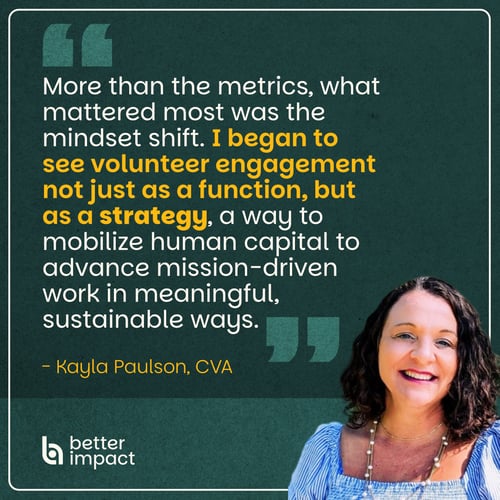
But more than the metrics, what mattered most was the mindset shift. I began to see volunteer engagement not just as a function, but as a strategy — a way to mobilize human capital to advance mission-driven work in meaningful, sustainable ways.
After ten years, I was given what I can only describe as the ultimate “trust fall.”
I had been collaborating with reDirect Foundation on the update of Points of Light’s Volunteer Engagement Training Program, as well as a learning circle grantee implementing a more supportive onboarding environment for people. During that work, they offered me what felt like my lottery job: the opportunity to help organizations do better and be better for the people that work and serve with them, and to provide funding to help remove barriers to this work.
More than four years ago, I made the difficult decision to step away from a role I loved so that I could support more organizations, communities, commissions, and companies in practicing strategic volunteer engagement.
Today, through my work as an independent consultant, trainer, and coach, I partner with organizations to build stronger systems, develop community and people-centered strategies, and create environments where volunteers and staff can thrive together.

Around the same time I became a free agent, I was serving as President-Elect of AL!VE (Association of Leaders in Volunteer Engagement) and had been a Service Enterprise trainer since the national pilot in 2012. When Points of Light announced they were looking for an organization to lead Service Enterprise into its next chapter, I knew this was a pivotal moment. Alongside Michelle Raymer, Megan Vixie, and Gretchen Jordan, we crafted a proposal grounded in a bold vision for the future of Service Enterprise. As part of that proposal, we outlined a new role for Service Enterprise Administrator.
What I didn’t fully realize at the time was: I was writing my own future job description. When AL!VE was awarded the contract, I was asked if I was resigning from my president-elect role to apply for the Service Enterprise Administrator contract position. After a moment of surprise, I recognized something important — I was uniquely qualified to help lead this transition and ensure its success.
It was another “yes, if…” moment. One that reinforced the power of trusting both your experience and your instincts, and having peers that know and trust you.
Trust both your experience and your instincts, and have peers that know and trust you.
Volunteer engagement is not static, and neither am I. Heck, I had a boss once ask me if I could ever do something the same way without trying to do better than the last time.
To stay current, I intentionally invest in both learning and contributing:
Equally important, I learn from my peers. This profession is rich with knowledge, and some of the best insights come from simply being in conversation with others who are navigating similar challenges and opportunities. One of the best things about designing and delivering co-learning experiences is that, even when I am delivering the training, I often learn from and with the participants.
I’ll be transparent: earning my CVA didn’t fundamentally change how I practice volunteer engagement, or how I showed up for staff, volunteers, or others. My approach was already rooted in a commitment to community-centered practices, human capital strategy, authentic relationships, and mission delivery. But it did change how others perceived me — and, perhaps more importantly, how I perceived myself.
Here’s my confession: I struggled with being afraid to fail. Yes, even after presenting on a national level. If it weren’t for the encouragement and support of my state commission, Volunteer Iowa, multiple conferences, and being invited to help lead and shape volunteer engagement, I’m not sure I would have sat for the exam. Self-doubt held me back for a long time. Earning my CVA in 2020 gave me something I didn’t realize I was missing: confidence and validation. It validated my experience, affirmed my expertise, and gave me a sense of pride in my ability as a volunteer engagement professional.
For those outside our field — people who may not fully understand the complexity and impact of what we do — the CVA provides external credibility. It signals that we aren’t just doing “nice work,” but essential, strategic work.
It signals that we aren’t just doing “nice work,” but essential, strategic work.
What excites me most right now is the shift I’m seeing across the sector.
More organizations are embracing the evolution of volunteerism. They’re moving away from thinking in terms of “our volunteers” and toward a more collaborative mindset — one where community members partner with staff to deliver the mission.
This shift requires us to rethink our language, systems, and assumptions. It challenges us to move from “doing for” to “doing with.” Community-centered volunteer engagement isn’t just a trend — it’s the future. And as professionals, we have both the opportunity and the responsibility to co-lead and facilitate that change.
There are a few guiding principles that have shaped my journey and continue to inform my work:
Take time to reflect on what you and your organization are uniquely qualified to do. We need to own both our awesomeness and our areas for growth.
Lean into opportunities, but set yourself up for success by identifying non-negotiables and the conditions you need to thrive.
Embrace a growth mindset. Instead of saying “we don’t have a strong culture of strategic volunteer engagement,” say “we don’t yet have…” You will get there — you just need the curiosity and willingness to explore.
The more we connect with and engage people and communities in co-creating things, the more likely we are to achieve sustainable and transformational change.
You are in a field that is both deeply meaningful and constantly evolving — but don’t worry, you are not in it alone. Here’s my advice to those new to the profession:
When I look back on my journey — from a “too vocal” employee to a national leader in volunteer engagement — I see a path shaped by people, purpose, and possibility.
My CVA didn’t define that journey, but it strengthened it. It gave me the confidence needed to step into new spaces, the credibility to influence broader conversations, and the reminder that this work — our work — is worthy of recognition and deserves investment. Invest in yourself and the profession. Go after your CVA, and continue to explore what’s next in your career and for your professional development.
You never know where a simple “yes, if” might lead.
Kayla is an experienced human capital engagement professional and trainer with a history of working across nonprofit change management, volunteer engagement, training, strategic planning, and facilitation. She partners with organizations to fully harness the capabilities of their people — both paid and unpaid — to achieve their mission. She serves as Treasurer for the Council for Certification in Volunteer Administration (CCVA) and as Service Enterprise Administrator for AL!VE.
Featured Posts
Table of Contents Where It All Started: A Twelve-Year-Old's Vision Stepping Into Volunteer Administration A New Chapter: Richmond Cares, Richmond...
Looking back on my time…
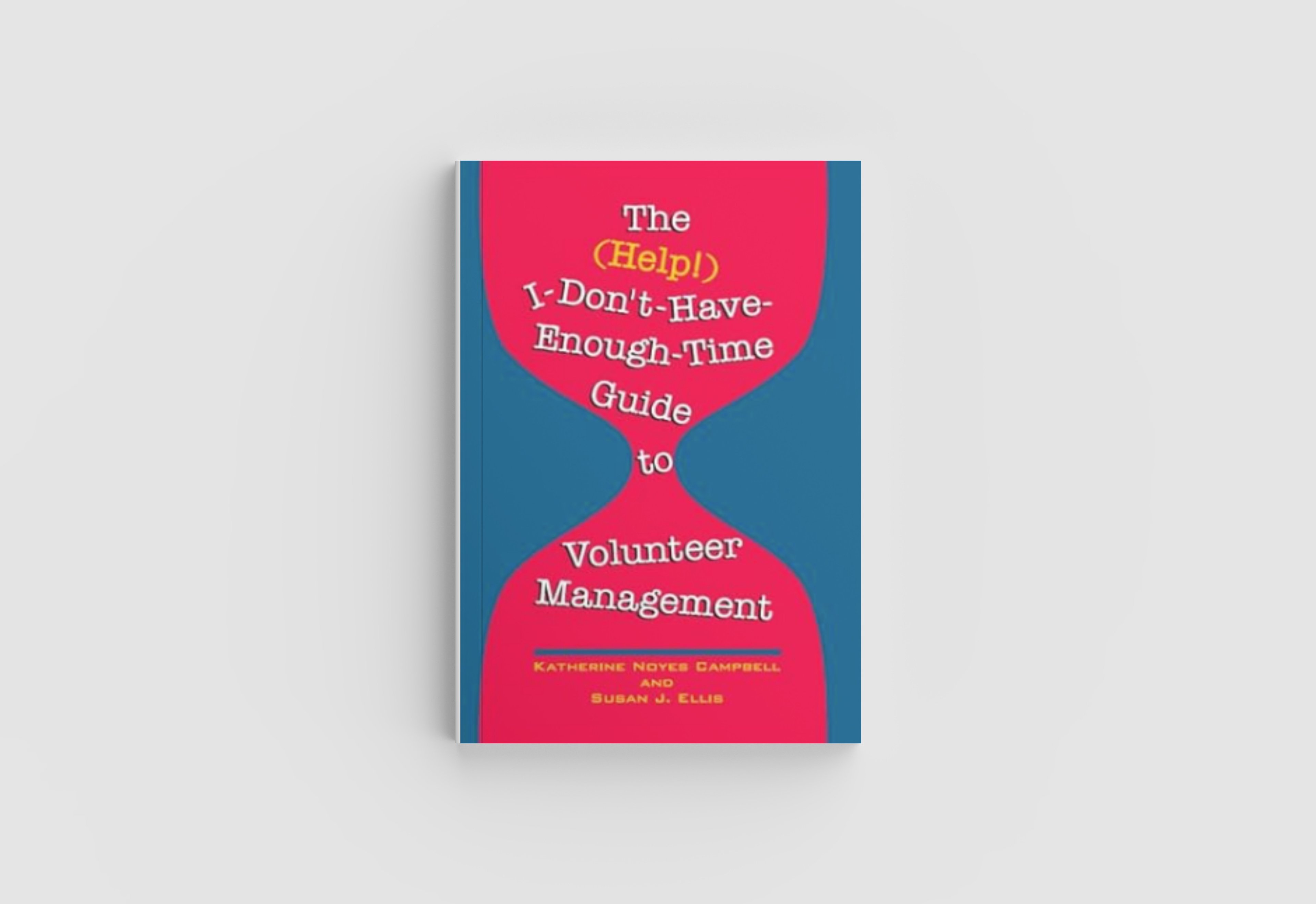
This Month’s Selection: The (Help!) I-Don't-Have-Enough-Time Guide to Volunteer Management By Katherine H. Campbell, CVA & Susan J. Ellis The fifth...