6 min read

Volunteer Management Training: Top Resources to Build Skills

Volunteer Management Training: Top Resources to Build Skills
14:03

If your organization relies on volunteers to further its mission, managing them effectively should be a top priority for your team. However, you may wonder where to start or how to navigate volunteer relations in today’s rapidly changing nonprofit landscape. This is where volunteer management training comes in!

Furthering your education in the field of volunteer management allows you to build a toolkit of strategies and skills for creating a program that can thrive long-term. In this guide, you’ll learn everything you need to know about volunteer management training, including:

Before we dive into the best resources available today, let’s begin by discussing the benefits of volunteer management training.

Level up your volunteer management capabilities with top-of-the-line software from Better Impact. Contact Us.

Why is training important for volunteer coordinators?

Volunteer management training is useful for all professionals in the nonprofit sector, whether you’re coordinating volunteers for the first time or you’re a seasoned manager trying to ensure your strategies remain relevant and effective. Even if your position doesn’t specifically focus on volunteer management, having some knowledge on this topic can be helpful if you interact with volunteers in any capacity.

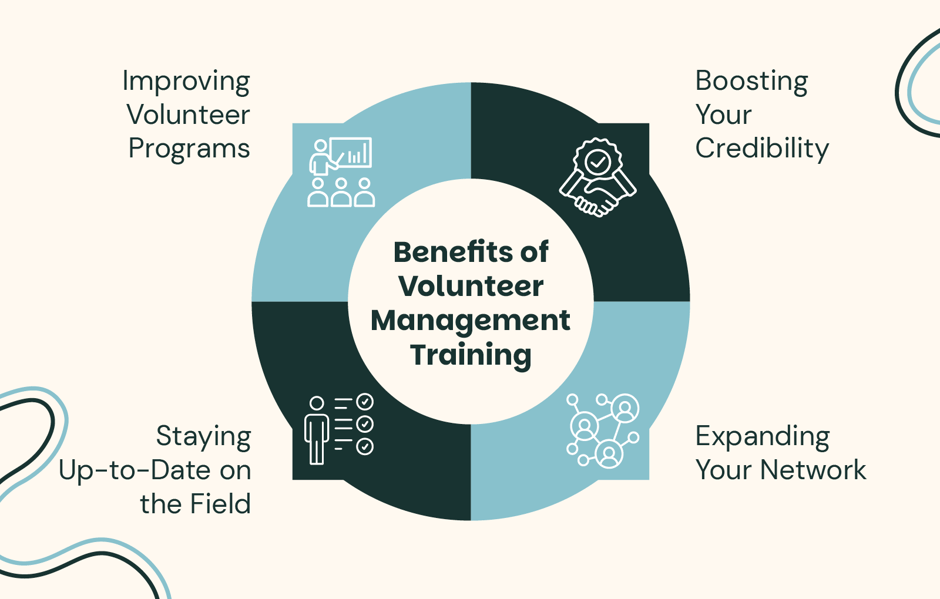
Here are a few specific benefits of intentionally developing your skills in this area:

A mind map of four benefits of volunteer management training, which are discussed below.

  • Improving your volunteer program. By undergoing professional development, you’ll be better equipped to recruit, engage, and retain volunteers, leading to a more positive experience for everyone involved. Plus, you can manage your volunteer program more efficiently, which saves your organization time and money.
  • Boosting your credibility as a manager. When volunteers know that the people coordinating them are knowledgeable about volunteering, it instills trust. If you display the credentials you’ve earned or cite resources you’ve used to educate yourself when training volunteers, you’ll demonstrate to them that they’re in good hands.
  • Expanding your professional network. Especially in collaborative training spaces, you can meet other dedicated volunteer managers and share ideas with them, allowing you to build community and tap into mentorship opportunities. Having more extensive training can also make you a more appealing candidate if you want to change jobs or pursue a promotion.
  • Staying up-to-date on changes in the field. Continuous learning ensures you always know about the current trends, technology, best practices, legalities, and ethical considerations involved in volunteer management. This knowledge minimizes risks and increases volunteer satisfaction.

Volunteer management training doesn’t just benefit you as a volunteer coordinator. The advantages of your training will also trickle down to your volunteers, other staff members at your organization, and other managers in your professional circle. 

Types of Volunteer Management Training

Your approach to improving your volunteer management skills can be formal or informal, independent or collaborative, online or offline—the possibilities for learning and development are endless! Generally speaking, most volunteer management training resources fall into one of the following categories:

A graphical list of five types of volunteer management training formats, arranged from most to least intensive and explained below.

  • Certifications: Comprehensive, standardized learning opportunities offered by recognized authorities or organizations in the volunteer space. Earning a certification can involve guided or independent study (or both) and typically ends with an extensive assessment to determine proficiency in multiple aspects of volunteer management.
  • Certificates: Shorter educational programs that can be broad or specific in their focus. They usually consist of several guided courses or sessions and also end with assessments, but the work involved is less detailed and demanding than certifications.
  • Conferences: Gatherings of volunteer management professionals that include multiple educational sessions and networking opportunities held over one or a few days. These may take place in person, virtually, or in a hybrid format.
  • Webinars and panels: Digital information sessions involving one (webinar) or a few (panel) experts on a specific volunteer-related topic, which may happen live or be recorded and made available for on-demand viewing. In live sessions, audiences can often submit questions for the presenter(s) to answer after they’ve covered their prepared material.
  • Blogs and newsletters: Online and print articles written by experts in volunteer management and other related topics. Don’t discount the value of reading free online publications in enhancing your volunteer management skills! Since these resources are often updated weekly or monthly, they’re among the best ways to learn about recent developments in the field.

When deciding which opportunities you want to incorporate into your professional development, consider your goals, learning preferences, time, and budget. If you still aren’t sure which type of training to pursue, we’ve put together this short quiz to help you decide!


Our Favorite Volunteer Management Training Opportunities & Resources

To help you find high-quality volunteer training opportunities that fit your needs, we’ve compiled a list of some of the best resources across all five categories discussed above. Feel free to browse the whole list or jump directly to the section that most interests you.

Certifications

  • Council for Certification in Volunteer Administration (CCVA). This global organization allows you to earn the title of Certified in Volunteer Administration (CVA) by self-studying for and passing an online exam offered twice a year. Because this is the top credential in the volunteer space, you’ll need to maintain it by earning Professional Development Units (PDUs) and renewing your certification every five years.
  • The Beryl Institute Credentialing Center. This organization offers a Certified Administrator of Volunteer Services (CAVS) credential for healthcare volunteer management professionals who pass a multiple-choice test offered twice a year. Requiring at least two years of paid experience as a prerequisite, the goal of CAVS is to recognize expertise, promote professional growth, and maintain global healthcare industry standards in volunteer management.
  • Volunteering Australia. For members of regional volunteer management organizations in Australia, their parent organization offers a Continuous Professional Development (CPD) Program that involves a combination of guided course completion, independent research, event attendance, and mentorship. As you complete CPD activities, you’ll earn points toward a Professional Leader of Volunteers (PLV) certification.

Certificates

  • Nonprofit Leadership Center. This certificate course consists of three half-days of interactive, in-person instruction with a Nonprofit Leadership Center trainer in Tampa, FL. Participants have to attend all three sessions on current volunteer management best practices in order, complete all assignments given during the course, and pass a quiz at the end of each training segment to earn a certificate awarded by the Florida Association for Volunteer Resource Management (FAVRM). 
  • North Carolina State University. Open to individuals with bachelor’s degrees and current NCSU students, the Graduate Certificate in Leadership and Volunteer Management requires participants to complete four online courses and achieve a 3.0 cumulative grade point average (GPA). It’s intended to enhance students’ work in organizational administration and volunteer management to prepare them for leadership roles in community-based organizations.
  • University of North Texas. UNT’s Volunteer and Community Resource Management Certificate “is designed for professionals and students who want to add a competitive edge to their careers through specialized training in volunteer management, leadership, community asset mapping, program planning and evaluation.” Applicants need a bachelor’s degree to enter the program and have to complete four online courses (three mandatory and one elective) during it.
  • Conestoga College. Conestoga College hosts the longest-running volunteer management certificate program in Canada, which consists of three online courses and a final portfolio project. Conestoga College's courses align with the accepted professional and program standards established by the Volunteer Management Professionals of Canada (VMPC), Volunteer Canada, and the National Occupational Standards.
  • Fleming College. This certificate, which requires four online courses, “focuses on the specialized skills set of managing volunteers as opposed to employees.” It was developed based on the standards and practices of the Human Resources Council of Canada and the VMPC.

Conferences

  • Better Impact's Volunteer Management Hybrid Conference. We host this one-day conference each fall in partnership with the VMPC and AL!VE to give volunteer managers a space to gain expert insights, learn actionable strategies, and connect with their peers across North America. Participants can register for the online-only experience or join one of the in-person groups hosted by various organizations around the United States and Canada.
  • Society for Healthcare Volunteer Leaders (SHVL) Annual Education Conference. This in-person conference currently held in Perdido Beach, AL, is open to members and non-members of SHVL—anyone interested in learning more about healthcare volunteer management. It offers three full days of keynote speakers, breakout sessions, and vendor shows.
  • Points of Light Social Impact Conference. Held in person in Washington, DC, over three days, this conference focuses on navigating change and leading with purpose at any organization that relies on volunteer service. Beginning with the 2026 Points of Light conference, it’s merged with the National Service-Learning Conference so experienced professionals and youth leaders can learn and create change side by side.
  • VMPC National Forum. This virtual one-day conference brings together volunteer leaders from across Canada to learn and grow professionally. It focuses primarily on volunteer engagement, including current challenges, innovations, and best practices for building relationships with volunteers.

Webinars & Panels

  • Idealist Volunteer Engagement Resources. Since its merger with VolunteerMatch, Idealist offers one-off webinars and series on topics ranging from volunteer appreciation strategies to ethical decision-making in volunteer leadership. They post recordings after each webinar so you can catch up on any sessions you may miss. Additionally, some webinars have free worksheets or sample documents you can download and use to follow along.
  • NXUnite by Nexus Marketing. NXUnite is an online community that “partners with leading experts and influencers in the nonprofit sector to bring you and your team educational sessions that will transform your operations.” Their webinars and panels focus on various topics related to nonprofit work, including volunteer management. By joining the community, you can also access networking opportunities as well as a back-catalog of event recordings.
  • Better Impact Webinars. Our webinars cover a wide range of topics, from volunteer engagement and relationship-building to credentialing and program insurance. We have different sessions that cater to audience members in different countries, and you can earn PDUs to maintain your certifications by attending. Plus, you can always watch our older webinars on demand!

Explore the Better Impact Webinar Library

Blogs & Newsletters

Wrapping Up: Additional Resources on Volunteer Management

The training opportunities above should help you advance your career and improve your ability to effectively engage and supervise volunteers. If you still aren’t sure which avenues are right for you, ask your fellow volunteer management professionals for their reviews of the resources they’ve used—oftentimes, firsthand perspectives are the most valuable!

For more information on volunteer management, check out these resources:

Volunteer management requires great training and the right tools to succeed. Discover how Volunteer Impact streamlines program administration and boosts engagement. Contact Us.


Better Impact's best list of conferences for volunteer management professionals around the world

Better Impact's best list of conferences for volunteer management professionals around the world

Introduction Conferences are one of the best ways for volunteer management professionals to connect and learn from one another. Volunteer managers...

Read More
Resources That Help Volunteer Management Professionals Be Their Best

1 min read

Resources That Help Volunteer Management Professionals Be Their Best

I’ve been working in volunteer leadership positions since 1989, and I can count on one hand the number of current colleagues who’ve also been leading...

Read More
Better Impact's best list of Associations for volunteer management professionals around the world

Better Impact's best list of Associations for volunteer management professionals around the world

Introduction Leading and supporting volunteer effort is all-too-often a lonely and largely unsupported role in many agencies, where funding may be...

Read More